When sourcing custom activewear, selecting the right manufacturing partner determines your product quality, delivery reliability, and brand reputation. Dongguan, the heart of China’s sportswear production corridor, hosts over 3,000 garment factories—but not all deliver the same value.
This guide provides a systematic framework for evaluating custom activewear manufacturer, covering certification requirements, production capabilities, and risk mitigation strategies essential for international brands.
Why Dongguan Dominates Global Activewear Manufacturing
The Complete Supply Chain Ecosystem
Dongguan’s competitive advantage lies not in labor costs alone, but in its vertically integrated supply network:
| Fabric sourcing | Same-day access to 10,000+ material suppliers at Humen International Fabric Market |
| Sample development | 3-5 day turnaround for prototype creation |
| Specialized equipment | Four-needle six-thread machines, laser cutters, heat-sealing systems |
| Logistics hub | 90-minute drive to Shenzhen Port; 48-hour air freight to major global cities |
For custom sportswear—where every team requires unique colors, every athlete needs specific fits—this ecosystem enables rapid iteration without sacrificing precision.
Technology Integration in 2026
Leading Dongguan factories have transitioned from traditional cut-and-sew to smart manufacturing:
- AI-powered nesting software increases fabric utilization to 95%+
- Automated cutting systems handle 50-layer stacks with ±0.1mm accuracy
- Digital workflow management provides real-time production tracking via client portals
- 3D sampling technology reduces physical prototype rounds by 40%
5 Critical Criteria for Factory Evaluation
1. Specialization vs. Generalization
Not every garment factory excels at performance apparel. Verify specific expertise in:
| Seam type | Four-needle six-thread (flatlock) for stretch fabrics |
| Construction | Heat-sealed seams for compression wear and waterproof gear |
| Fabric knowledge | Experience with moisture-wicking knits, 4-way stretch, recycled polyester |
| Quality systems | AQL 2.5 standard or stricter for premium lines |
Request physical samples of similar products. Examine stitch density (12-14 stitches per inch for sportswear), seam elasticity, and fabric hand-feel.
2. Certification Portfolio
Essential certifications for international markets:
| ISO 9001:2015 | Quality management systems | Required |
| BSCI / SEDEX | Social compliance and ethical sourcing | Required for EU/US retailers |
| OEKO-TEX Standard 100 | Chemical safety in textiles | Required for skin-contact products |
| GRS (Global Recycled Standard) | Recycled content verification | Required for sustainability claims |
| ISO 14001 | Environmental management | Preferred for eco-conscious brands |
Verify certificate validity through official databases—fake documentation remains common in the industry.
3. Minimum Order Quantities (MOQ) Structure
Dongguan factories offer varying flexibility tiers:
| Factory tier | Typical MOQ | Best suited for |
| Large-scale OEM | 1,000-3,000 pcs/color | Established brands, basic styles |
| Mid-size custom | 200-500 pcs/style | Growing brands, multi-SKU lines |
| Flexible specialist | 50-100 pcs | Startups, test markets, limited drops |
Some factories offer consolidated MOQs—500 pieces total across 3 colors—to support brand development phases.
4. Sampling Protocol and Timeline
Professional sampling workflow:
| Stage | Deliverable | Timeline | Purpose |
| Tech pack review | Feasibility assessment | 1-2 days | Identify construction challenges |
| First sample | Fit sample (raw fabric) | 5-7 days | Validate pattern and proportions |
| Second sample | PP sample (correct fabric/trim) | 7-10 days | Confirm materials and construction |
| Pre-production | Golden seal sample | 3-5 days | Production benchmark |
Factories charging $50-100 per sample typically invest in proper development; sub-$20 samples often indicate rushed, non-representative prototypes.
5. Communication Infrastructure
Evaluate before committing:
- Dedicated account manager with fluent English (or your target language)
- Response time commitment (24-hour maximum during business days)
- Project management tools (Trello, Monday.com, or proprietary systems)
- Video inspection capability for remote quality verification
- Clear escalation path for production issues
OEM vs. ODM: Selecting Your Partnership Model
OEM (Original Equipment Manufacturing)
You provide complete specifications; factory executes production.
| Requirements | Tech pack with flat sketches, measurements, material specs, construction details |
| Investment | Higher upfront (pattern development, sampling) |
| Advantages | Full design control; exclusive products; higher margins |
| Challenges | Longer development cycle (6-10 weeks); requires technical expertise |
ODM (Original Design Manufacturing)
Factory provides existing designs; you customize labels and minor details.
| Requirements | Style selection from catalog; logo placement; color/pack-size specifications |
| Investment | Lower upfront; faster to market |
| Advantages | 2-3 week delivery; tested patterns; reduced risk |
| Challenges | Limited differentiation; potential market saturation; IP considerations |
Hybrid approach: Many Dongguan factories now offer “semi-customization”—modifying existing blocks with your unique design elements, balancing speed and exclusivity.
2026 Manufacturing Trends: What to Demand from Your Factory
Sustainability as Standard
Environmental compliance is transitioning from premium feature to baseline requirement:
- Recycled content: REPREVE®, ECONYL®, and rPET integration at 30-50% composition
- Waterless dyeing: Supercritical CO2 and dope-dyed yarns reducing water consumption 95%
- Zero-waste cutting: AI nesting + creative pattern engineering achieving 3% fabric waste vs. industry 15%
- Biodegradable packaging: Cornstarch polybags and recycled cardboard boxes
Smart Manufacturing Integration
Next-generation production capabilities:
| Technology | Application | Benefit |
| Body scanning integration | Made-to-measure athletic wear | Perfect fit without alterations |
| Conductive thread embroidery | Biometric monitoring integration | Seamless sensor placement |
| On-demand sublimation | Full-print customization | No MOQ for complex graphics |
Distributed Manufacturing Networks
Leading Dongguan factories now operate “digital front-end + global micro-factories” models—design and sample in China, produce closer to end markets for faster replenishment.
Step-by-Step Cooperation Workflow
Phase 1: Due Diligence (Week 1-2)
- Request factory profile, certification copies, and client references
- Conduct video facility tour or third-party audit (SGS, Bureau Veritas)
- Submit initial tech pack for feasibility review
- Negotiate payment terms (typically 30% deposit, 70% before shipment)
- Execute NDA and manufacturing agreement
Phase 2: Development (Week 3-6)
- Confirm fabric sourcing (stock vs. custom dyeing)
- Review first fit sample; provide detailed revision notes
- Approve pre-production sample (seal as “golden standard”)
- Finalize size grading and measurement tolerances
Phase 3: Production (Week 7-12)
- Fabric inspection (4-point system or 10% AQL)
- Inline inspection at 30% completion
- Final random inspection before shipment
- Third-party lab testing (color fastness, dimensional stability, performance properties)
Phase 4: Logistics & Continuity
- Flexible shipping terms: FOB Shenzhen, EXW Dongguan, or DDP options
- Digital pattern archiving for 2-week reorder turnaround
- Post-delivery quality warranty (typically 30-60 days)
Risk Mitigation: Common Pitfalls to Avoid
Pitfall 1: Price-Only Evaluation
Low initial quotes often exclude:
- Fabric pre-shrinking treatments
- Quality trim upgrades (YKK zippers vs. generic)
- Specialized construction (laser cutting, bonded seams)
Solution: Request detailed BOM (Bill of Materials) breakdown and confirm “no hidden cost” clause in contract.
Pitfall 2: Skipping Sample Stages
Compression wear and fitted activewear require precise pattern engineering. Rushing to production without fit verification results in costly returns and brand damage.
Solution: Budget 3-4 sample rounds; conduct wear-testing with target body types.
Pitfall 3: Ignoring Fabric Lead Times
Imported technical fabrics (Lycra®, Cordura®, Polartec®) require 6-8 week procurement. Domestic alternatives offer 2-week availability but may differ in performance.
Solution: Map fabric sourcing timeline before confirming delivery dates with customers.
Pitfall 4: Informal Communication
WeChat or WhatsApp agreements lack legal standing. Design changes, delivery extensions, and quality disputes require documented confirmation.
Solution: Maintain email trail for all contractual matters; use cloud-based specification sheets with version control.
Pitfall 5: Unclear IP Protection
ODM factories may resell your successful designs to competitors. Without explicit agreements, pattern ownership remains ambiguous.
Solution: Secure exclusive production rights for custom-developed patterns; register designs in key markets.
Conclusion: Building Strategic Manufacturing Partnerships
Selecting a Dongguan sportswear factory transcends transactional sourcing—it requires aligning with a partner invested in your brand growth. Superior manufacturers contribute technical consultation, material innovation access, and market intelligence beyond basic production.
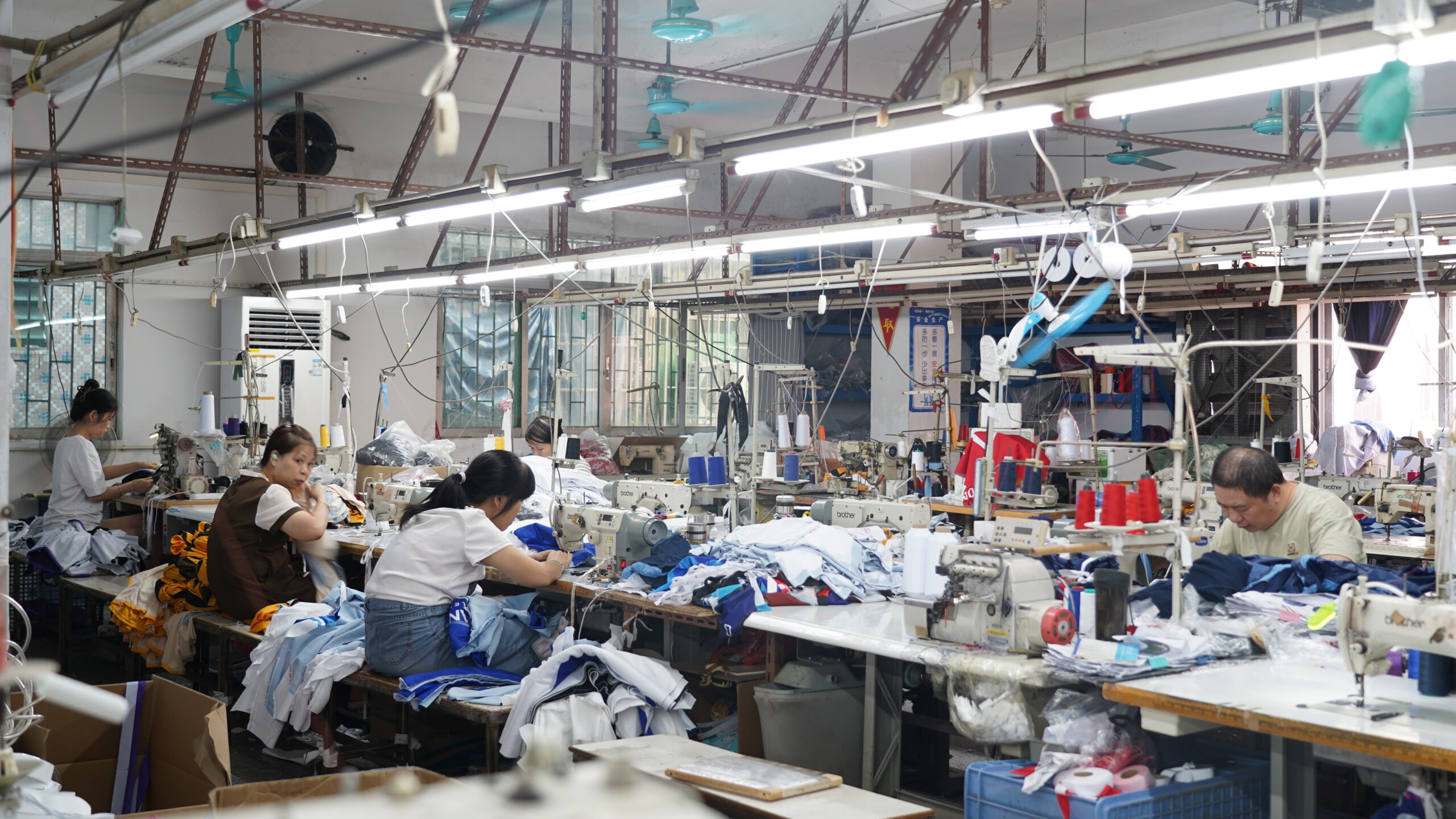
During facility evaluation, observe:
- Workshop organization (5S methodology implementation)
- Worker skill level and retention rates (low turnover indicates fair treatment)
- Quality station independence (QC staff reporting separately from production)
- Raw material storage conditions (climate control for moisture-sensitive fabrics)
In competitive activewear markets, your manufacturing capability defines your product ceiling. Systematic evaluation, clear communication protocols, and mutual commitment to quality create the foundation for scalable brand success.
About QEOK Factory: We are a Dongguan-based technical sportswear manufacturer specializing in yoga wear, compression garments, and team sports uniforms. With 10+ years of export experience and certifications including BSCI, OEKO-TEX, and GRS, we provide OEM/ODM services from concept to delivery. MOQ starts at 200 pieces with 3-week sampling turnaround.
Contact our team for a complimentary sample kit and detailed capability presentation.